
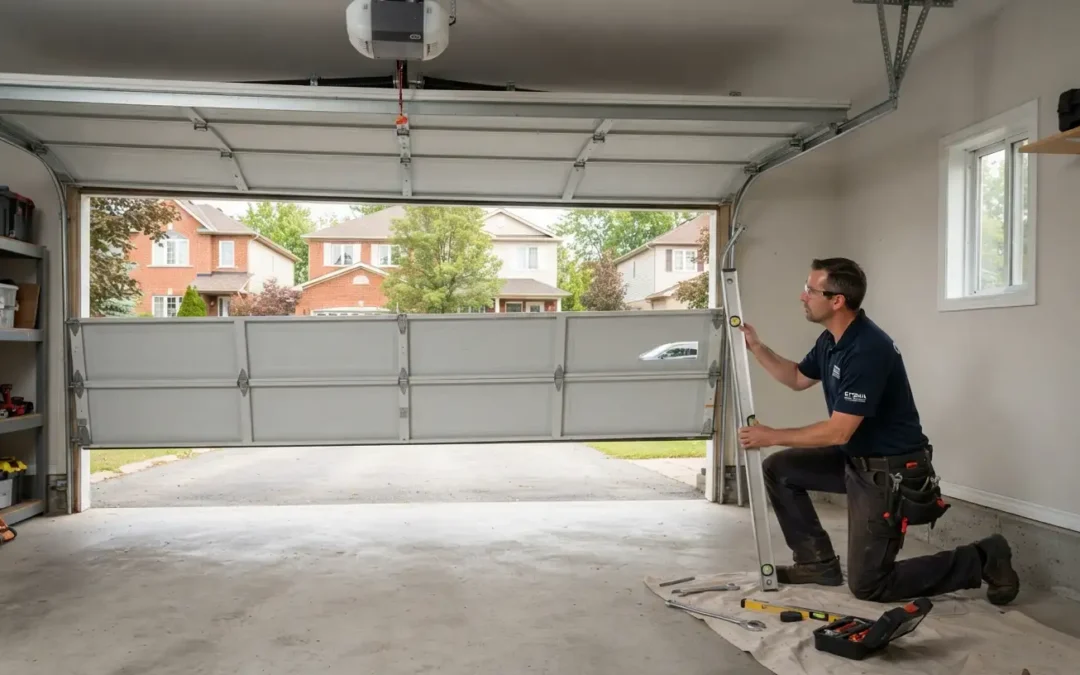
Garage door tracks are supposed to provide a clear, controlled path from the floor to the ceiling. When that path changes even slightly, the symptoms show up quickly. The door may scrape, shake, hesitate, sit crooked, or stop before completing its travel.
Track problems range from a slightly loose alignment to a door that has partially come out of the track. The difference matters because continuing to operate a badly misaligned door can damage rollers, panels, cables, and other hardware. This guide explains how to recognize garage door track problems, what causes them, and when it is time for professional repair. As a garage door company Ottawa homeowners rely on, Amigo Door repairs track and alignment problems throughout the region.
What Garage Door Tracks Do
A sectional garage door uses vertical and horizontal tracks to guide the rollers. The vertical tracks carry the door upward from the opening. Curved sections transition the rollers overhead, where the horizontal tracks support the open door.
For the system to work smoothly, those tracks need to stay correctly positioned relative to each other and to the door. If one side moves, bends, or loosens, the rollers no longer travel through the same path.
That can turn a simple alignment issue into a larger garage door repair if the door is forced to keep moving.
Signs Your Garage Door Tracks Need Attention
Track problems often reveal themselves through movement and sound.
Watch for:
- Scraping or grinding from one side of the door
- A garage door that shakes or jerks
- One side rising faster than the other
- Visible gaps between rollers and the track
- A track that looks bent, twisted, or pushed inward
- Loose track brackets
- Rollers that appear close to coming out
- A door that sticks at the same point every time
- Fresh scrape marks on the track or roller stems
If a roller has already left the track or the door is hanging at an angle, stop operating it. That is no longer a minor alignment problem.
A door that is severely crooked, jammed, or unsecured may need emergency garage door repair.
Bent, Misaligned, and Off-Track Are Not the Same Thing
These terms are often used interchangeably, but they describe different stages of a problem.
Misaligned Track
The track may still be physically straight but has shifted from its proper position. Loose mounting hardware or movement in the structure can change the alignment enough for the rollers to bind.
Bent Track
The metal itself has been deformed, often after an impact. Even a localized bend can interfere with roller movement.
Off-Track Door
One or more rollers have left the track entirely. This can happen after severe misalignment, impact, a cable problem, roller failure, or another mechanical issue.
An off-track door deserves its own detailed discussion in a future guide. For now, the important rule is not to keep cycling a door once the rollers have left their intended path.
What Causes Garage Door Track Problems?
Several problems can move or damage the tracks:
- A vehicle or object striking the lower track
- Loose mounting brackets
- Worn or seized rollers
- Broken or loose cables
- A garage door moving out of balance
- Panel or hinge damage pulling the door out of line
- Long-term vibration and normal hardware movement
- Corrosion or physical damage to the track
Sometimes the track is the failed component. Other times it is showing the effects of a problem somewhere else.
For example, a worn hinge can change panel alignment and force rollers sideways. Our guide to garage door hinge repair explains how that small component can eventually affect the tracking system.
When a Track Problem Is Actually a Roller or Cable Problem
Tracks do not operate in isolation. If one side of the door suddenly drops or becomes crooked, a cable problem may be creating the misalignment. If the door is noisy along the entire path, worn rollers may be dragging through otherwise straight tracks.
Likewise, poor garage door balance can cause the door to move unpredictably and put uneven forces on the hardware.
A professional inspection should therefore look at:
- Track position and condition
- Rollers
- Cables
- Hinges
- Springs and balance
- Door panels and mounting points
Repairing the track without correcting the cause can lead to the same problem returning.
What You Can Safely Check Yourself
There are a few things homeowners can inspect without taking the system apart. With the door stationary, you can look for obvious debris, visible dents, loose-looking hardware, scrape marks, or a roller that appears badly out of position. You can also listen and watch during normal operation if the door is still moving safely.
What you should not do is hammer a bent track back into shape, loosen structural track brackets, force rollers back into place, or operate a door that is already hanging crooked.
Garage doors are heavy, and track position is tied closely to rollers, cables, and the counterbalance system. Professional garage door technicians can determine whether alignment is enough or damaged hardware needs replacement.
How Professional Track Repair Works
The first step is determining whether the track can be realigned or whether the metal has been damaged badly enough to require replacement.
A technician also checks why the problem occurred. If an impact bent the track, the repair may be relatively contained. If a cable, roller, hinge, or balance issue pulled the door out of line, that underlying problem needs attention too.
Once the track and related hardware are corrected, the door is operated through its full travel to make sure the rollers move smoothly without rubbing or binding.
Our garage door repair costs guide explains why pricing differs between minor alignment and more substantial track replacement.
How Ottawa Conditions Affect Garage Door Tracks
Tracks are inside the garage, but they are not completely protected from Ottawa weather.
Snow, water, grit, and road salt come in on vehicles and footwear, particularly around the lower vertical track. Over time that moisture can encourage corrosion on hardware and create debris that interferes with smooth movement.
Regular garage door maintenance helps keep the travel path clean and gives worn rollers or loose hardware a chance to be caught before they create alignment problems.
When Track Damage Is Part of a Bigger Door Problem
A badly bent track can sometimes accompany impact damage to the door itself.
If a vehicle has struck the garage door, inspect more than the visible track. Panels, hinges, rollers, brackets, and cables may all have absorbed part of the force.
Our guide to garage door panel damage explains when panel repair is enough and when more extensive work may make sense.
For older doors with several failing components, it may also be worth comparing repair with a new garage door installation.
Track Problems on Commercial Doors
A track issue on a commercial garage door can interrupt access to a loading area, warehouse, service bay, or other high-traffic opening. Commercial doors may also be larger and cycle more often, making alignment and hardware condition especially important.
Early service is usually preferable to waiting until the door jams or leaves the track completely.
Local Track Repair Across Ottawa
Amigo Door provides track alignment and related garage-door repair throughout Ottawa and surrounding communities. Visit our areas of service to check coverage near you.
The Bottom Line
A garage door should move through its tracks without scraping, twisting, or fighting its way past a tight spot. If the track looks bent, the door is moving unevenly, or a roller is beginning to leave its path, stop treating the symptom as normal wear. Early track repair can prevent damage to rollers, cables, panels, hinges, and the opener.
Noticing scraping, crooked movement, or a visibly damaged track? Contact Amigo Door at 1-613-821-2898 or visit our contact page to arrange an inspection.
Recent Comments